
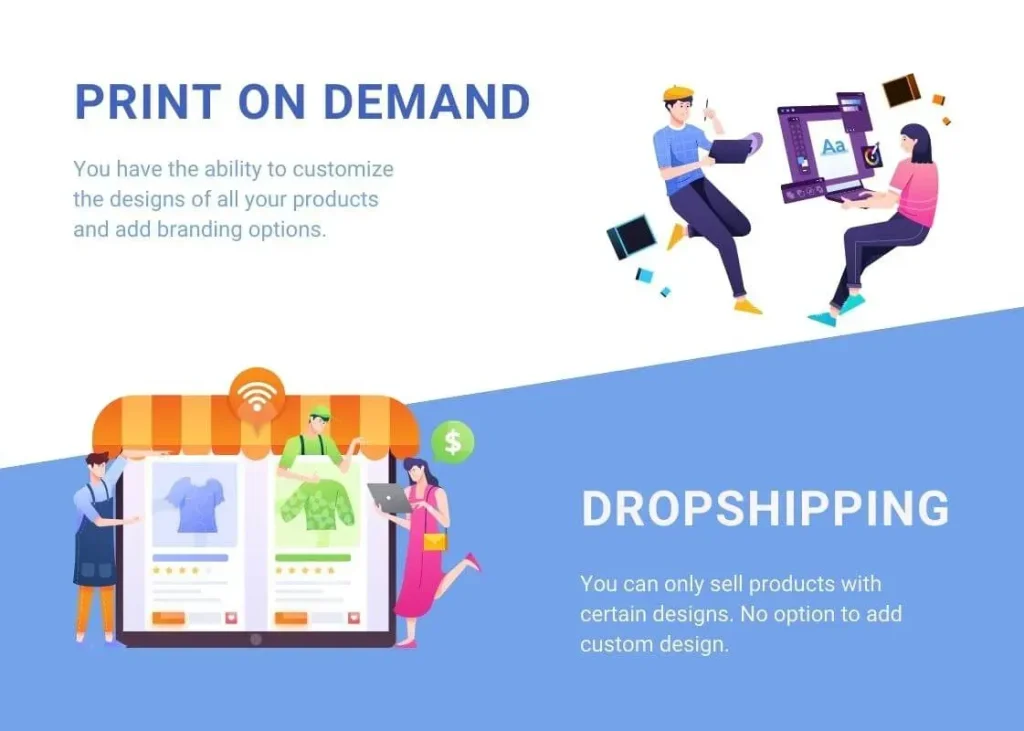
Print on Demand vs Dropshipping is a pivotal choice for any ecommerce business exploring fulfillment options. Both models offer low upfront costs and flexible product selection, yet they differ in how products are produced, stored, and shipped. Understanding print on demand costs and dropshipping costs helps you price items accurately and forecast margins. You’ll also compare POD vs dropshipping pros and cons to identify which approach aligns with your branding, speed, and scale. Finally, consider how inventory management for POD and dropshipping shapes your fulfillment strategies POD vs dropshipping and customer experience.
From another angle, the same concept is often described as on-demand printing and direct-to-consumer fulfillment. Instead of stocking merchandise, brands partner with printers or manufacturers to produce items after an order is placed, while logistics partners handle storage and shipping. This lens highlights how cost structure, supplier reliability, and delivery timelines shape customer satisfaction and growth potential.
1. Understanding the Cost Landscape: POD Costs vs Dropshipping Costs
Print on Demand costs typically consist of base item costs, printing/production fees, and shipping. Because items are produced to order, you avoid warehousing and carrying costs, reducing inventory risk. However, unit costs tend to be higher than bulk purchases, so margins hinge on design value, pricing strategy, and volume. When evaluating print on demand costs, compare the base price, printing method (DTG, sublimation, embroidery), minimum order requirements, production capacity, and shipping speed.
Dropshipping costs include the supplier price, shipping, and any platform or app fees needed to manage orders. While you can add a wide catalog with minimal upfront investment, margins can be thinner due to competition, shipping times, and supplier fee structures. Also consider returns handling, restocking costs, and integration fees—these are all part of the total cost of ownership for both models.
2. POD vs Dropshipping Pros and Cons for Branding, Speed, and Profitability
POD shines when branding and customization are central. You control product design, packaging, and the unboxing experience, which supports premium pricing and repeat purchases. This is a clear example of the POD advantages in building a differentiated brand, and it highlights the POD vs dropshipping pros and cons in terms of customer perception and loyalty.
Dropshipping offers a broad product catalog, rapid testing of niches, and low upfront costs, enabling fast market entry and scalable experiments. However, margins can be tighter, branding opportunities may be constrained by supplier packaging and quality, and there is increased dependence on partners. Weighing the POD vs dropshipping pros and cons helps determine whether breadth or branding control should drive your strategy.
3. Inventory Management for POD and Dropshipping: Strategies for Reliability and Scale
Because POD involves production on demand, finished goods inventory is rarely held. Inventory management for POD and dropshipping shifts to design management, supplier relationships, and production lead times. Practical strategies include clear design guidelines, mockups to reduce reprints, ordering samples to validate quality, diversifying print providers, and listing production times so customers understand delivery windows.
Dropshipping inventory management requires vigilant supplier coordination to prevent stockouts and delays. Implement real-time stock monitoring, automated alerts from suppliers, safety stock thresholds for best-sellers, regular supplier audits, and performance scoring. Transparent communication with customers about shipping times and potential delays helps maintain trust when inventory shifts occur.
4. Fulfillment Strategies POD vs Dropshipping: Choosing the Right Path for Your Store
POD fulfillment centers on producing items to order, so production times influence overall shipping estimates and customer satisfaction. Clearly state production timelines on product pages, offer fast shipping where feasible, and maintain consistent packaging that reinforces your brand. This is part of the fulfillment strategies POD vs dropshipping approach, ensuring expectations align with reality.
Dropshipping fulfillment hinges on supplier reliability and effective order management. Vet suppliers for consistent packaging, quality, and on-time shipping; automate fulfillment tasks with order management software; provide realistic delivery timelines, and establish transparent returns processing. Coordinating multiple suppliers while preserving a cohesive brand experience is a central element of fulfillment strategies POD vs dropshipping.
5. Print on Demand vs Dropshipping: Which Model Supports Growth and Brand Consistency?
Choosing between Print on Demand vs Dropshipping depends on your product type, branding goals, and growth trajectory. Print on Demand is ideal for design-driven products where customization and a strong brand experience command higher value, while dropshipping offers catalog breadth and speed to market. This decision shapes your margins, throughput, and how you set customer expectations across channels.
Many successful stores blend both models: core POD items to reinforce branding, plus a carefully curated dropship category to expand catalog without overcommitting capital. Focus on supplier vetting, regular sample testing, and clear customer communication to maintain a cohesive experience across fulfillment paths while protecting margins and delivery speed.
Frequently Asked Questions
Print on Demand vs Dropshipping: what are the key pros and cons for choosing a fulfillment model?
Print on Demand vs Dropshipping offers distinct advantages. POD excels at branding and zero finished goods inventory, but it often has higher per-unit costs and longer production times. Dropshipping provides a broad product catalog and low upfront costs, yet margins can be slimmer and branding may be limited by supplier packaging. Your choice should hinge on your brand goals, required speed, and tolerance for supplier dependencies.
In the Print on Demand vs Dropshipping comparison, how do print on demand costs compare to dropshipping costs?
POD costs include the base product, printing/production, and per-item shipping, with no warehousing. Dropshipping costs cover the wholesale product price, supplier shipping, and platform or integration fees. Generally POD has higher per-unit costs but eliminates warehousing, while dropshipping keeps upfront costs low but requires careful pricing to preserve margins; both models benefit from negotiating provider rates and optimizing shipping options.
What are best practices for inventory management for POD and dropshipping within Print on Demand vs Dropshipping?
Regarding inventory management for POD and dropshipping: POD involves production on demand, so you typically do not hold finished goods; focus on design guidelines, supplier reliability, and quality control; ordering samples helps verify print quality before scaling. For dropshipping, maintain real-time stock monitoring, safety stock thresholds for best-sellers, regular supplier audits, and clear customer communication about shipping times.
What fulfillment strategies POD vs dropshipping should you consider when evaluating Print on Demand vs Dropshipping?
Key fulfillment strategies include setting clear production and shipping timelines on product pages, offering expedited options for popular designs, and using order management software to automate fulfillment across providers. Also align packaging and branding where possible for POD and ensure transparent return policies that reflect supplier realities.
Which scenario is better for a hybrid model under Print on Demand vs Dropshipping, and how do costs and fulfillment differ?
A hybrid approach combines POD for branded, customizable core products with dropshipped items to broaden your catalog. Expect higher unit costs and branding control with POD, versus lower margins and branding limits with dropshipped products; coordinate two suppliers with unified messaging, and use cross-channel inventory visibility and streamlined returns processes to maintain a cohesive customer experience.
| Aspect | Print on Demand (POD) | Dropshipping |
|---|---|---|
| Model concept | Production-on-demand; items are printed/made for each order; no finished inventory; relies on third-party print providers. | Retailer sells products stocked/shipped by a supplier; the retailer never handles the product. |
| Inventory management | No finished goods inventory; focus on design management, supplier relationships; multiple providers to avoid single points of failure. | Real-time stock monitoring; safety stock thresholds; supplier audits; transparent communication about shipping times. |
| Costs | Base item price + printing/production fee + per-item shipping; higher unit costs; no warehousing; unlimited design potential. | Product cost + shipping to customer; platform/app fees; returns/restocking; potential batching or split shipments impact margins. |
| Pros | Strong branding potential through customization; low upfront risk; easy testing of designs; scalable by adding designs. | Large product catalogs; low upfront costs; faster scaling; flexible supplier network. |
| Cons | Higher per-unit costs; longer fulfillment due to production; design/quality risks; depends on supplier reliability. | Margins can be tight; branding limitations; dependency on supplier reliability; quality control challenges. |
| Fulfillment & speed | Production/printing times; shipping speeds depend on print provider; can offer fast options for non-custom items with clear production estimates. | Relies on supplier accuracy and shipping; use automation to manage orders; provide realistic delivery timelines and transparent returns. |
| When to choose | Best for custom designs, strong branding, and personalized products; lower upfront risk with high branding control. | Best for broad product catalogs, rapid testing, and scalable growth with minimal stock; comfortable with supplier management. |
| Hybrid approach | Core products via POD to showcase branding; complement with a dropship line for breadth; align branding for a cohesive experience. | Use dropshipping for non-customized staples or accessories; maintain strong supplier relationships and cohesive branding. |
| Pitfalls & mitigations | Quality/consistency checks; diversify providers; set production timelines; sample regularly; clear refunds for production realities. | Quality control challenges; supplier reliability; accurate shipping estimates; defined returns process; avoid single vendor dependency. |
| Case examples | Niche apparel with POD designs plus a small dropship line; focus on on-brand packaging and quick shipping for non-custom items. | Home décor with POD wall art and dropship seasonal items; test niches without heavy inventory |
Summary
Table summarizes key points comparing Print on Demand (POD) and Dropshipping: how they work, inventory, costs, pros/cons, fulfillment, and strategic use cases. It shows when to choose POD, when to opt for dropshipping, and how a hybrid approach can balance branding with breadth. The conclusion below reinforces the decision criteria and strategic pathways for selecting the best model for your ecommerce goals.